
Convair F-106A “Delta Dart”
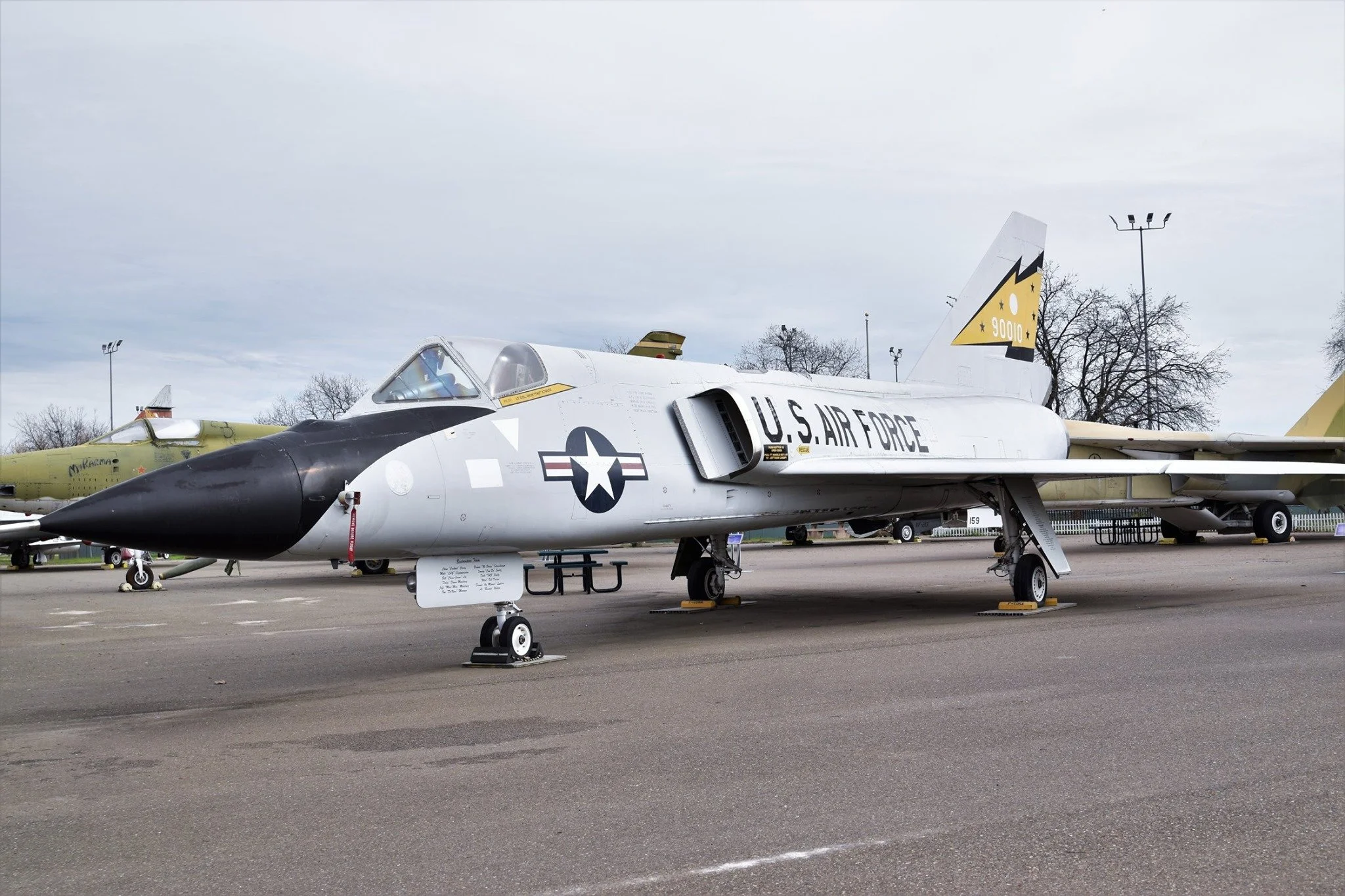
The single seat, single engine, delta-wing, Mach 2, F-106 Delta Dart fighter interceptor was the cornerstone of the strategic air defense of the United States from 1959 through 1987. Designed to intercept and destroy the Soviet bomber threat in the Cold War, the Delta Dart carried sophisticated radar and infrared missiles, including a nuclear tipped rocket to defeat attacking fleets of bombers. Later a six-barrel 20 mm Gatling-type machine gun replaced the rocket as the F-106 was deployed worldwide to counter possible threats from fighters.
Equipped as an all-weather, day or night fighter, the Dart used encrypted data link and a computer-controlled radar fire control system to find, track, lock-on and destroy an adversary aircraft regardless of electronic counter-counter measures, jamming, or decoy processes. The F-106 was considered the most challenging of fighters to fly due to its heavy cockpit workload.
Today, the F-106 still holds the record as the fastest single engine fighter in the world, having achieved over 1,525 miles per hour. The Delta Dart could snap climb to over 65,000 feet. Internal armament and special supersonic tanks allowed the F-106 to achieve a combat radius of over 700 miles and without refueling. One example flew 2,075 miles non-stop. Its unique Coke bottle shape and delta wing design proved the F-106 to be highly maneuverable and it was used in the adversary role against the Navy Top Gun School and as simulated enemy forces at Red Flag Exercises.
Painted in its original assigned colors of the 5th Fighter Squadron, aircraft 59-0010 survived a mid-air collision where it lost the first 14 feet of its nose. Its last assignment was to be towed by a C-141 to test the feasibility of launching satellites from its internal bay into space. The Sacramento Air Logistics Center was the assigned repair depot for the F-106s and processed virtually all F-106s from 1959 through to 1985. Volunteers from the Aerospace Museum of California restored this aircraft in 2005/6.
Specifications
Serial Number: 59-0010
Crew: One pilot
Production:
277 F-106As, 63 F-106Bs
Mission – Interceptor:
Primary – Strategic Defense
Secondary – Aerial Supremacy
Power Plant:
One Pratt & Whitney J75-P17, thrust 16,100 lbs (71.6 kN)
Thrust, in afterburner – 24,500 lbs (108.9 kN)
Dimensions:
Wing Span: 38 ft 4 in. (11.7 m)
Length: 70 ft 9 in. (21.6 m)
Height: 20 ft 4 in. (6.2 m)
Weight:
Gross, Empty – 24,861 lbs. (11,275 kg)
Maximum – 41,831 lbs. (18,970 kg)
Performance:
Speed: Maximum – Mach 2.4 at 40,000 ft, Mach 1.1 at Sea Level, .93 Mach cruise
Ceiling: 56,000 ft. (17,070 m)
Combat radius: 735 miles (1,183 km)
Armament:
Two AIM-4F Radar Missiles, Two AIM-4G Infrared Missiles, One AIR-2A Genie Nuclear Rocket, or one M61 Gatling-type 20 mm cannon with 450 rounds
THIS AIRCRAFT IS ON LOAN FROM THE NATIONAL MUSEUM OF THE UNITED STATES AIR FORCE